


Aneta A. Teperek, Ph.D
Founder & Chairperson of a Global Organization
Visionary Innovator
Academic Researcher
Author of Academic Books
Entrepreneur
Founder and CEO of Multiple Companies
Start-up Mentor
Board Advisor
Business Consultant
Academic and Professional Background
My professional experience reflects two lifelong passions: science, inspired by my Dad, and business, which has been a part of my life since early childhood thanks to my Mom—a remarkable businesswoman. While pursuing both an academic path and an entrepreneurial career, the theoretical knowledge I acquired proved immensely valuable. After earning a Master’s degree in Finance and Banking from the Warsaw School of Economics (SGH) in Poland, I continued my education in the United States, focusing on business and management. Over the course of two years, I completed several executive education programs at Harvard Business School and the Wharton School, which equipped me with the foundational knowledge for a business career spanning over two decades, serving as the founder and CEO of several successful start-ups in IT consulting, real estate development, and international trade. The ability to quickly learn new business sectors, together with strong organizational and leadership skills, has allowed me to adapt to changing market conditions and operate in diverse cross-cultural environments.
As part of my entrepreneurial ventures, I have undertaken extensive international travel, visiting more than 90 countries across both large and small economies. The smaller ones drew my particular attention, which resulted in-depth research, the culmination of which was my doctoral thesis, defended at the Warsaw School of Economics (SGH) in Poland, focusing on the participation of the world’s smallest economies in globalization processes. Driven by a profound desire to further expand my knowledge on the world’s smallest economies—collectively generating only 1% of global GDP, with each economy not exceeding US$29 billion in 2019, and numbering 93 in total—I pursued postdoctoral studies at the Polytechnic University of Leiria in Portugal, with a focus on the tourism sector in these economies. Concurrently, I independently continued to deepen my expertise, exploring the geographical conditions, cultural contexts, political systems, historical backgrounds, as well as economic and demographic trends of these countries. This extensive research resulted in the authorship of three scholarly books on the world’s 93 smallest economies, two of which were published by Palgrave Macmillan and distributed globally, with the third currently in the process of publication. My current one-year research project, conducted at the Geneva Graduate Institute within the Department of International Economics, focuses on poverty reduction in the smallest economies in Africa.
.jpg)
Recognizing both the marginalization of the world’s smallest economies on the global stage, their domination by large economies, and the need for an organization that would serve as the voice of the world’s smallest economies, I founded the Organization for the Smallest Economies in the World (OSEW). My dual academic–entrepreneurial background provided the conceptual and operational foundation for OSEW’s mission and project portfolio.
By offering both academic research and business consultancy, OSEW develops initiatives aimed at raising global awareness and understanding of the challenges faced by the world’s smallest economies, facilitating their international cooperation and supporting their sustainable economic, social, and environmental development. The organization promotes knowledge exchange and the sharing of best practices among these 93 economies, enabling the least developed to benefit from the experiences of the more advanced.
Selected Publications
The book Economic Development in the World's Smallest Economies - how Geography, Demographics, and Culture Define Economic Activity exams three fundamental factors that influence economic growth and development: geographic, demographic, and cultural conditions within the 93 smallest economies in the world. The objective of the study is to assess whether these nations posses the necessary environmental resources, human capital, and cultural attributes conducive to economic development, and weather they are effectively utilizing them. The book begins with an overview of the world's smallest economies, including a detailed analysis of the geographical location, neighboring countries, and land area. It then explores elements of physical geography such as climate zones, soil types, landforms, geological structures, and water resources. It evaluates how
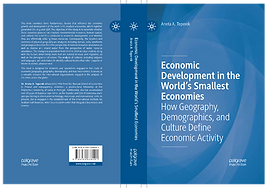
climate zones, soil fertility, topography, and hydrological systems impact key sectors such as agriculture and transportation; how geological composition affects the availability of mineral resources and the development of mining sector; and how access to sea waters creates opportunities for tourism, fishing and offshore mining. In addition, the book analysis the demographic characteristics of these world's 93 smallest economies, tracing population changes from 1970 to 2019 and examining key factors such as natural increase and migration. It also considers demographic structure, emphasizing its vital role in shaping economic development. Finally, the book explores cultural dimensions— including religions, languages, and ethnicities—and their influence on economic activity, highlighting cultural features that may either support or hinder economic growth and development of the world's smallest economies.
The book Long-Term Economic Growth in the World's Smallest Economies: Historical, Political, and Economical Aspects offers a comprehensive examination of the historical, political, and economic factors that influence the growth and development of the world’s 93 smallest economies. The book opens with an overview of global economic history, followed by an in-depth analysis of the specific historical trajectories of the world's smallest economies. This analysis is structured around a typology that includes: countries established through colonial processes, those that experienced decades of socialism, and those that have functioned as independent states for years or even centuries. These unique historical paths are evaluated in terms of their influence on the present-day economic conditions of each country. The book also explores political systems, emphasizing how the type of regime—whether democratic or

authoritarian—affects governance stability, policy implementation, and institutional effectiveness, all of which play a significant role in economic development. Furthermore, it assesses the participation of the world's smallest economies in regional and international organizations, analyzing the extent to which such membership contributes to accelerating economic development. A substantial portion of the book is dedicated to economic analysis of the GDP dynamics of the world’s smallest economies between 1970 and 2019, as well as the annual per capita GDP growth rate between 2000 and 2019 and the causes of these changes, primarily from among political, demographic, and geographical factors. In summary, an examination was conducted of the socio-economic levels of these 93 countries, with the Human Development Index (HDI) serving as the primary metric. Given its capacity to incorporate social dimensions, it is a more comprehensive metric for evaluating overall quality of life, thus offering a more precise assessment in comparison to GDP per capita.
Other Publications